Contents 15 sections
A Turkish invoice must identify the supplier, customer, transaction and applicable tax treatment. It must generally be issued within seven days of the delivery or service, use the correct electronic document type and contain enough detail to support both parties’ accounting and tax records.
A payment receipt, contract or bank transfer does not replace a compliant invoice. Conversely, an invoice does not by itself prove that goods were delivered or a service was genuinely performed. Turkish businesses need the invoice and the underlying commercial evidence to be consistent.
The principal invoice rules are found in Tax Procedure Law No. 213. VAT Law, electronic-document communiqués and commercial-document requirements can add further information depending on the transaction and the taxpayer’s status.
Mandatory Information on a Turkish Invoice
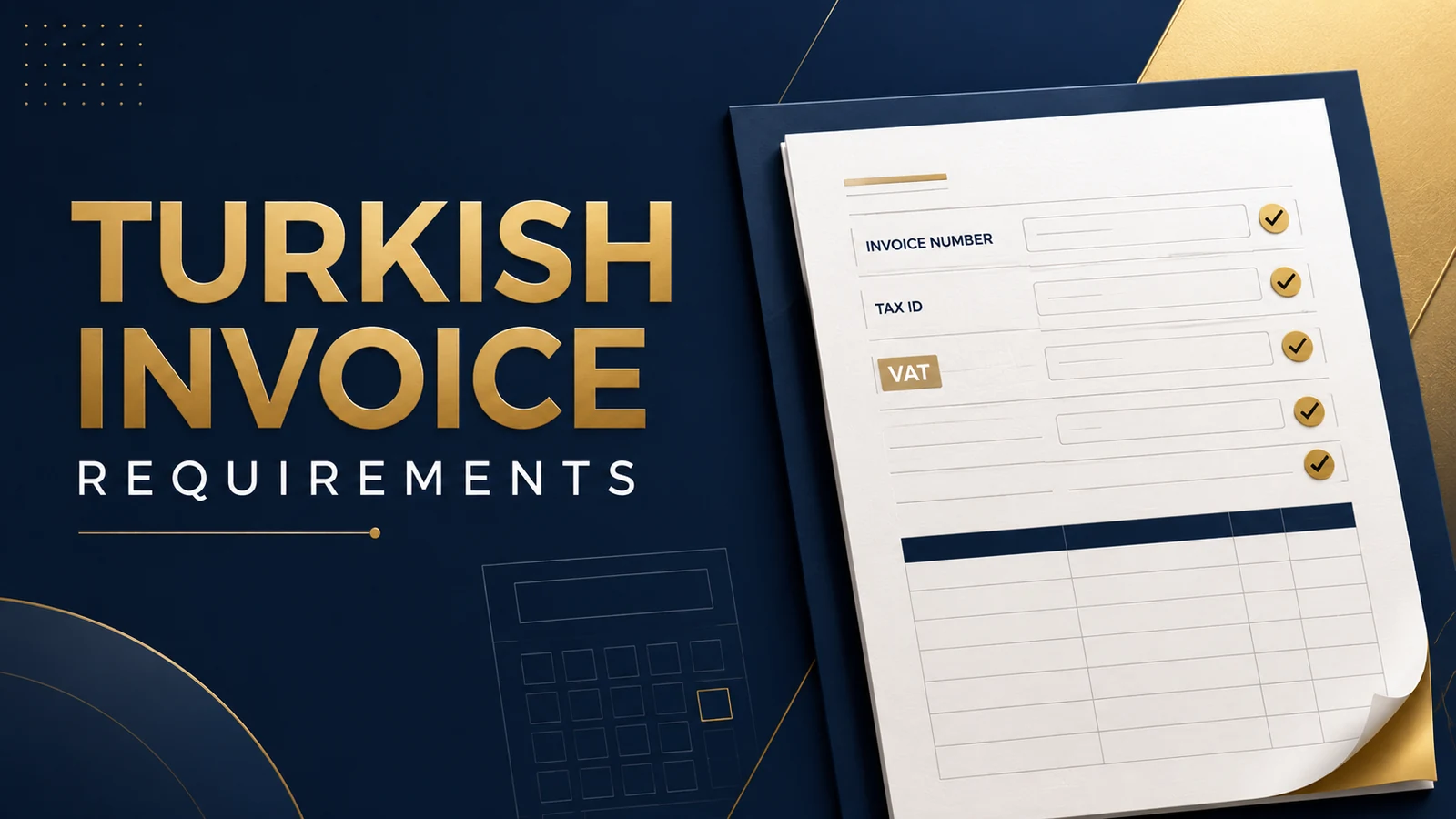
Article 230 of the Tax Procedure Law establishes the minimum invoice content. The required information should be accurate, readable and consistent with the seller’s and customer’s official records.
| Required field | What it should show | Common problem |
|---|---|---|
| Invoice date | The date on which the invoice is issued. | Using the payment date without checking the delivery or service date. |
| Serial and sequence number | A unique number following the applicable consecutive numbering structure. | Duplicate, skipped or manually altered numbers. |
| Supplier details | Name or trade name, business address, tax office and tax identification number. | Using an abbreviated trade name or outdated registered address. |
| Customer details | Name or trade name, address, tax office and tax identification number where applicable. | Entering a group company, branch or employee instead of the legal customer. |
| Goods or service description | The type and nature of the supplied goods or performed service. | Generic descriptions such as “service fee” that do not explain the transaction. |
| Quantity, unit price and amount | The quantity or measurable unit, price per unit and transaction amount. | An unsupported lump sum or a total inconsistent with the contract. |
| Delivery information | For goods, the delivery date and delivery-note number where applicable. | The invoice cannot be matched to the physical movement of goods. |
Identity check: The customer’s trade name and tax number should be verified before the first invoice. A familiar brand, branch name or group name may not be the legal entity that purchased the goods or service.
The Seven-Day Invoice Rule
Under Article 231 of the Tax Procedure Law, an invoice must generally be issued within a maximum of seven days following the delivery of goods or performance of the service. An invoice issued after that period is treated as not issued for the relevant penalty provision.
The commercial team should therefore record the actual supply date rather than waiting for payment, internal approval or month-end bookkeeping. A contract may provide a later payment date, but this does not automatically postpone the statutory invoice deadline.
| Event | Relevant control | Do not assume |
|---|---|---|
| Goods delivered | Record the dispatch and delivery date and link the delivery note. | That the invoice can wait until the customer pays. |
| Service completed | Determine when the agreed service was performed or completed. | That internal acceptance always changes the tax date. |
| Continuing service | Apply the invoicing period and supply rules relevant to the service. | That every continuing service has the same tax point. |
| Advance received | Distinguish an advance collection from the actual supply and any invoice voluntarily issued. | That every bank receipt has identical VAT and invoice consequences. |
Operational recommendation: Do not use the seventh day as the normal invoicing date. A shorter internal deadline leaves time to verify the customer’s tax number, electronic registration and VAT treatment.
When Is an Invoice Required?
Transactions between merchants, companies, self-employed professionals and other parties covered by Article 232 generally require an invoice regardless of the amount. The annual invoice threshold should not be used to avoid invoicing an ordinary business-to-business transaction.
For qualifying retail sales and services supplied to final consumers, the official invoice issuance threshold is TRY 12,000 for 2026. An invoice is required when the transaction exceeds the applicable threshold or when the customer requests one, even if the amount is lower.
Threshold warning: The TRY 12,000 figure is primarily relevant to the distinction between an invoice and qualifying retail documentation. It is not a general exemption from invoicing business customers.
VAT Information on the Invoice
In addition to the Tax Procedure Law fields, a taxable invoice should present the VAT calculation clearly. The document will ordinarily show:
- the value of goods or services before VAT;
- discounts or other adjustments affecting the taxable amount;
- the applicable VAT rate for each line or category;
- the VAT amount;
- the amount payable including VAT; and
- any required exemption, special-base or VAT-withholding code and explanation.
Different supplies on the same invoice can be subject to different VAT rates or treatments. Combining them under one undifferentiated total can produce an incorrect VAT calculation and make the customer’s input VAT review more difficult.
Where the supply is exempt, zero-rated, subject to a special taxable base or covered by VAT withholding, the invoice should use the correct system code and statutory explanation. Simply entering “VAT 0%” does not identify why VAT was not charged.
e-Invoice, e-Archive Invoice or Paper Invoice?
The statutory content is only one part of compliance. The supplier must also issue the invoice through the correct channel.
| Document type | Typical use | Main control |
|---|---|---|
| e-Fatura | An electronic invoice issued to a recipient registered in the e-Fatura system. | Check the recipient’s registration status at the time of issuance and use the appropriate scenario. |
| e-Arşiv Fatura | An electronic invoice issued outside the registered-recipient e-Fatura flow, including invoices to many consumers and non-registered recipients. | Apply Communiqué No. 509, current 2026 scope rules and the correct delivery method. |
| Paper invoice | Only where paper issuance remains permitted under the taxpayer’s status and current electronic-document rules. | Do not use paper merely because the electronic system or internal approval process is inconvenient. |
From 1 January 2026, the amount-independent e-Arşiv issuance requirement applies more broadly to taxpayers outside the ordinary e-Arşiv application, subject to the exceptions and deferred categories under Communiqué No. 509. The company’s own registration, business category and the recipient’s status must therefore be checked rather than relying only on the invoice amount.
Detailed cancellation and objection scenarios are separate from correct initial issuance and should be reviewed according to the document scenario, delivery status and applicable electronic platform.
Businesses implementing an electronic document workflow can review our E-Transformation and Digital Tax Compliance in Turkey service.
The XML File and the Visual PDF
An electronic invoice is more than the PDF or visual rendering sent by email. The structured electronic file contains the legally relevant data used by the GİB system, private integrator and accounting software.
The supplier and customer should retain the original electronic document and its validation or delivery data as required. Saving only the visible PDF can make it difficult to establish the original file, electronic signature, status and system history.
Archive control: Confirm that XML files, readable visual copies, delivery records and related accounting documents can be retrieved by company, year and invoice number. Our Statutory Books and Accounting Records in Turkey guide explains the overlapping retention periods.
Invoices in Foreign Currency
Turkish tax documents can state amounts in a foreign currency, but documents issued to domestic customers should generally also show the Turkish-lira equivalent under Article 215 of the Tax Procedure Law. Invoices issued to customers abroad are excepted from the requirement to display the Turkish-lira equivalent.
The invoice should identify the currency and applied exchange rate clearly enough to support the Turkish-lira accounting entry and VAT calculation. The invoice rate, accounting valuation and later payment exchange difference should not be treated as the same calculation automatically.
Invoices Issued to Foreign Customers
A foreign customer may not have a Turkish tax identification number or Turkish tax office. The electronic document should use the fields and identifiers permitted for a foreign recipient while showing the customer’s correct legal name and foreign address.
The customer being located abroad does not automatically make the supply exempt from Turkish VAT. The company must separately determine whether the transaction qualifies as an export of goods, an export of services or another exempt supply and retain the evidence required for that treatment.
For a service export, the contract, service output, customer location, place of benefit, correspondence and payment evidence may all be relevant. An English-language invoice or a foreign-currency payment alone does not establish the exemption.
Commercial Information Beyond the Tax Fields
The minimum fields in Article 230 should not be treated as the only information that can apply to a company invoice. Turkish Commercial Code rules and electronic templates can require or support additional details such as:
- the company’s registered trade name and registered office;
- trade registry and MERSIS information where applicable;
- the statutory website address for companies subject to the website obligation;
- electronic document scenario and profile information;
- payment account or due-date information;
- order, contract, project or delivery-note references; and
- sector-specific licence, customs or transaction data.
Commercial references should help reconcile the invoice without obscuring or contradicting the statutory tax information.
Reviewing an Incoming Supplier Invoice
The customer should not post and pay every received document automatically. A basic incoming-invoice review should answer the following questions:
- Is the customer correct? Confirm the company’s full trade name, address and tax number.
- Is the supplier genuine? Match its registration, bank account and commercial contact details.
- Was the correct document type used? Check e-Fatura registration and the supplier’s electronic-document obligations.
- Was the supply received? Match the invoice to the order, contract, delivery note, service report or acceptance record.
- Are the quantities and prices correct? Investigate differences before approval.
- Is the VAT treatment supported? Check the rate, taxable base, exemption or withholding code.
- Is the date reasonable? Compare the issue date with delivery, service and accounting cut-off records.
- Is the invoice a duplicate? Search by supplier, number, amount, date and electronic identifier.
A formally correct invoice can still represent a private, fictitious, duplicate or non-deductible expense. The business connection and supporting evidence should be reviewed separately. See our Deductible Business Expenses in Turkey guide for the tax deduction test.
Common Turkish Invoice Errors
| Error | Why it matters | Recommended control |
|---|---|---|
| Incorrect customer tax number | The invoice may be assigned to the wrong taxpayer or rejected by the electronic system. | Validate customer master data before issuance. |
| Invoice issued after seven days | The document is treated as not issued for the relevant penalty rule. | Trigger invoicing from delivery and service-completion records. |
| Wrong electronic document type | A paper or e-Arşiv document may be invalid where e-Fatura was required. | Check recipient and supplier registration status automatically. |
| Generic service description | The nature, business purpose and tax treatment cannot be established. | Reference the service period, project or deliverable. |
| Incorrect VAT rate or code | The supplier’s output VAT and customer’s input VAT can both be affected. | Maintain product and service tax codes with documented review. |
| Missing delivery-note reference | Goods movement cannot be reconciled with the invoice. | Integrate warehouse, dispatch and invoicing records. |
| Domestic foreign-currency invoice without TRY equivalent | The document may not comply with Article 215 requirements. | Show the currency, applied rate and Turkish-lira equivalent. |
| Keeping only the PDF | The original structured electronic file and status history may be lost. | Archive the original XML, visual copy and delivery data together. |
| Invoice inconsistent with the contract | Quantity, price, currency, service period or legal customer may be disputed. | Use a purchase-order and contract-matching workflow. |
Invoice Penalties in 2026
Article 353 of the Tax Procedure Law provides special irregularity penalties where an invoice or required electronic invoice is not issued or received, contains an amount different from the actual amount, is issued as paper when an electronic document was required or is treated as not issued.
For 2026, the minimum penalty for a first detection concerning these documents is TRY 17,000 per document, or 10% of the amount or difference that should have appeared on the document if that calculation is higher. Increased amounts apply to later detections during the same calendar year, subject to the statutory per-detection and annual caps.
Penalty amounts are not the only exposure: An incorrect invoice can also affect VAT deductions, revenue recognition, withholding tax, expense deductibility and the reliability of statutory books. Current consequences are discussed in our Tax Penalties in Turkey guide.
Invoice Controls for Foreign-Owned Companies
- maintain Turkish legal names and tax numbers separately from international group names;
- confirm whether a branch or the Turkish legal entity is the actual contracting customer;
- record delivery and service-completion dates in the operational system;
- validate e-Fatura recipient status before every invoice or through an automated master-data check;
- map products and services to current VAT rates, exemptions and withholding codes;
- review intercompany service descriptions and allocation references before issuance;
- reconcile foreign-currency invoices to Turkish-lira accounting records;
- match invoices with contracts, purchase orders, delivery notes and service evidence;
- retain original electronic files rather than relying on email attachments; and
- reconcile sales invoices, VAT returns, customer balances and revenue accounts each month.
Our Tax, Bookkeeping and Accounting Services in Turkey cover recurring invoice controls, statutory accounting, electronic-document coordination, VAT reconciliations and monthly compliance for Turkish and foreign-owned companies.
Build a Reliable Turkish Invoicing Workflow
We help companies verify invoice fields, customer records, VAT treatments, electronic document status and monthly accounting reconciliations.
Official Sources
- Turkish Revenue Administration: Tax Procedure Law No. 213
- GİB Istanbul: 2026 Invoice Issuance Threshold
- Turkish Revenue Administration: VAT Law No. 3065
- GİB Electronic Document Portal
- GİB: Amendment to Electronic Document Communiqué No. 509
- GİB: Tax Procedure Law General Communiqué No. 593
- GİB: 2026 Statutory Amounts and General Communiqué No. 588
Reviewed on 26 August 2026. This article provides general information. Invoice requirements can differ according to the taxpayer’s electronic-document status, recipient, transaction type, sector, VAT treatment and effective legislation. Current GİB rules should be checked before implementation.

Share this guide with your network
Choose a platform and share the article with its title, link and preview image ready.
Need advisory on this topic?
Contact us by WhatsApp or phone, or submit your request using the short form below.