Contents 14 sections
Turkish companies should generally organise their accounting and commercial archives around a 10-year retention period. Although the Tax Procedure Law establishes a five-year period for tax books and supporting documents, the Turkish Commercial Code and social security legislation impose longer obligations on many of the same records.
A foreign-owned Turkish company cannot rely solely on its overseas parent, accounting firm or cloud provider to retain its statutory records. The Turkish entity remains responsible for keeping complete, accessible and readable books and documents and producing them when requested by a competent authority or court.
The applicable period depends on why a record must be kept. Tax, commercial, social security, employment, sector-specific and personal-data rules may apply simultaneously. The safest retention date is therefore not always the five-year period most commonly associated with Turkish tax records.
Quick Overview of Record Retention Periods
| Legal basis | General period | Records covered |
|---|---|---|
| Tax Procedure Law | 5 years beginning with the calendar year following the relevant year. | Tax books, invoices, expense documents and other records supporting tax entries. |
| Turkish Commercial Code | 10 years from the end of the calendar year containing the relevant entry, document or financial statement. | Commercial books, financial statements, annual reports, commercial correspondence and supporting accounting documents. |
| Social Security Law | 10 years for private-sector employers, beginning with the year following the relevant year. | Workplace books, payroll, employment and social security records relevant to an SGK inspection. |
| e-Defter rules | For the periods required by tax law, the Commercial Code and other applicable legislation. | Electronic ledger files, certificates known as berat files, accounting vouchers and verification data. |
Practical policy: Where the same invoice, payroll record or ledger supports tax, commercial and social security obligations, destroying it after five years can breach a continuing 10-year obligation.
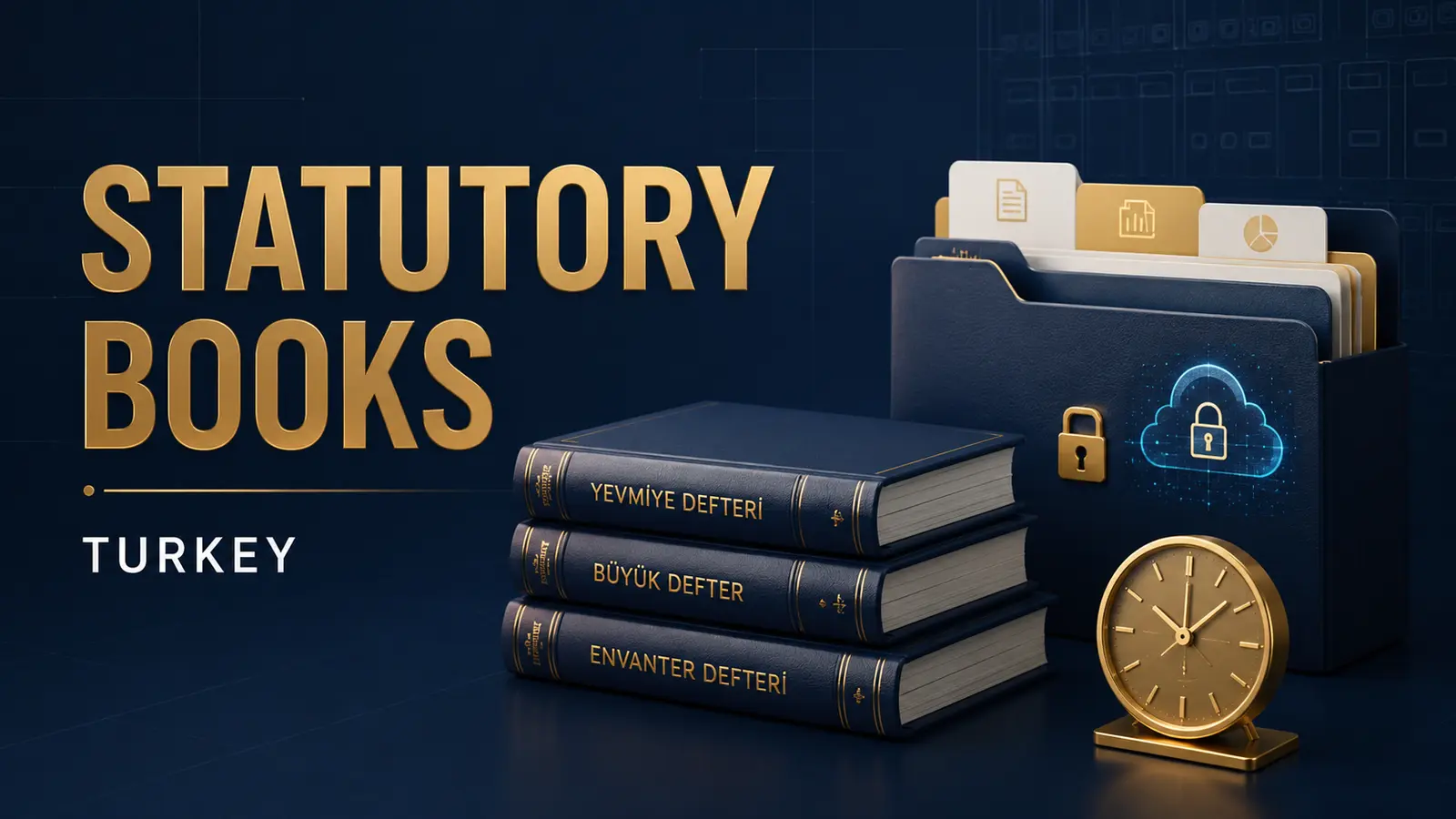
Which Statutory Books Must a Turkish Company Keep?
The books required depend on the company’s legal form, activities and electronic-record obligations. A Turkish limited liability or joint-stock company will commonly maintain both accounting books and corporate governance books.
| Book | Turkish name | Principal purpose |
|---|---|---|
| Journal | Yevmiye defteri | Records accounting transactions chronologically on the basis of supporting documents. |
| General ledger | Defteri kebir | Classifies journal entries under the relevant accounting accounts. |
| Inventory book | Envanter defteri | Records inventories, opening balances, year-end balances and related financial information. |
| Share ledger | Pay defteri | Records shareholders, shares and qualifying share transfers. |
| General assembly meeting and negotiation book | Genel kurul toplantı ve müzakere defteri | Records general assembly minutes and shareholder resolutions. |
| Board of directors resolution book | Yönetim kurulu karar defteri | Records board decisions of a joint-stock company. |
| Managers’ board resolution book | Müdürler kurulu karar defteri | May be maintained separately by a limited company for management decisions; if opened separately, the applicable commercial-book rules must be followed. |
Additional books can be required because of the company’s sector, tax status or specific activities. Physical books must satisfy the applicable opening, renewal and closing approval requirements. Electronic books follow their relevant electronic approval and system rules instead of ordinary physical notarisation procedures.
Why Do Turkish Rules Refer to Both Five and Ten Years?
The five- and 10-year periods come from different legislation and protect different interests.
- The five-year Tax Procedure Law period concerns the retention and production of tax books and documents.
- The 10-year Commercial Code period protects commercial accountability, financial reporting and the availability of evidence in corporate or commercial disputes.
- The 10-year Social Security Law period enables SGK to review workplace, employment, payroll and contribution records.
A supplier invoice can fall within all three categories. It supports a tax deduction, forms the basis of an accounting entry and may be relevant to a commercial claim. A payroll document can also support corporate tax, withholding and social security declarations at the same time.
Do not apply the shortest period automatically: Companies should classify records under every applicable rule and use the longest unexpired period, subject to litigation holds and sector-specific requirements.
How Is the Retention Period Calculated?
Under the Tax Procedure Law, the five-year period begins at the start of the calendar year following the year to which the book or document relates.
Under the Turkish Commercial Code, the 10-year period begins at the end of the calendar year in which:
- the final entry was made in the commercial book;
- the inventory was prepared;
- the relevant financial statement or consolidated statement was prepared;
- the commercial correspondence occurred; or
- the supporting accounting document was created.
Example for 2026 Accounting Records
| Rule | Period begins | General retention endpoint |
|---|---|---|
| Tax Procedure Law | 1 January 2027 | End of 31 December 2031 |
| Turkish Commercial Code | End of the relevant 2026 calendar year | End of 31 December 2036 |
| SGK records of a private employer | 1 January 2027 | End of 31 December 2036 |
These are general examples. A pending tax examination, court case, employee dispute, refund claim, loss carry-forward, investment incentive or sector-specific rule can justify or require a longer period.
Which Accounting Documents Should Be Retained?
The archive should contain more than the statutory ledgers themselves. A company must also preserve the documents and data needed to understand and verify the entries.
| Record group | Examples |
|---|---|
| Sales and purchases | Invoices, e-invoices, e-archive invoices, expense vouchers, delivery notes, receipts and customs records. |
| Banking and payment | Bank statements, payment confirmations, collection records, loan agreements and credit-card statements. |
| Payroll and employment | Employment contracts, payroll sheets, time records, benefit calculations, withholding records and SGK declarations. |
| Assets and inventory | Purchase documents, depreciation schedules, stock counts, warehouse records and disposal documents. |
| Tax compliance | Returns, accrual slips, payment receipts, withholding certificates, refund files and supporting calculations. |
| Corporate governance | Articles of association, board and shareholder resolutions, share records, annual reports and financial statements. |
| Commercial evidence | Contracts, orders, confirmations, delivery evidence and commercial correspondence connected with transactions. |
| Related-party transactions | Intercompany agreements, service reports, allocation calculations, loan schedules and transfer-pricing documentation. |
The records supporting expenses are particularly important because an invoice alone may not prove the business purpose or performance of a service. Our Deductible Business Expenses in Turkey guide explains the evidence expected for common expenses and foreign group charges.
Electronic Accounting Books: e-Defter
Companies within the e-Defter system create their applicable accounting ledgers electronically. For affected companies, electronically maintained ledgers replace the corresponding paper books; printing the files does not create a legally valid substitute.
The company must retain the following components together:
- the original e-Defter files;
- the corresponding berat files containing the required GİB approval data;
- electronic or physical accounting vouchers supporting the entries;
- electronic signatures, financial seals and related validation information where required;
- software or viewing tools needed to make the files accessible and readable; and
- the required stored copies uploaded to GİB or an authorised storage provider.
GİB storage is not a substitute for company control: Uploading a ledger, berat or required copy does not transfer the company’s legal responsibility to GİB, its accountant, software supplier or private integrator.
The original electronic files must remain accessible through the taxpayer’s own information systems. Storage by a third party or outside Turkey does not remove the taxpayer’s responsibility. The e-Defter rules specifically require the relevant retention obligation to be fulfilled within Turkey and under Turkish law.
Companies that need help with electronic ledgers, e-invoices and digital document workflows can review our E-Transformation and Digital Tax Compliance in Turkey service.
Electronic Corporate Books: ETDS
ETDS, the Electronic Commercial Ledger System operated by the Ministry of Trade, should not be confused with GİB’s e-Defter system.
| System | Primary authority | Books concerned |
|---|---|---|
| e-Defter | Turkish Revenue Administration | Electronic accounting ledgers, principally the journal and general ledger under the applicable system rules. |
| ETDS | Ministry of Trade | Share ledger, general assembly meeting and negotiation book and, where selected, the board resolution book. |
Companies registered on or after 1 January 2026 must maintain their share ledger and general assembly meeting and negotiation book through ETDS. Companies whose incorporation and articles amendments are subject to Ministry of Trade permission were also required to complete the relevant transition by 1 January 2026. Keeping the board of directors resolution book through ETDS remains optional under the current general framework.
Records generated through ETDS can be produced with a system verification code and do not require an additional notarised copy merely because they are submitted to an authority. The company must still assign authorised users carefully and ensure that decisions and shareholder records are entered completely and on time.
Records Held by an External Accountant
Outsourcing bookkeeping does not outsource the company’s statutory responsibility. Directors should know where physical and electronic records are located and should be able to retrieve them without depending on one individual’s email account, computer or password.
A formal handover when changing accountants should cover:
- physical statutory books and notarisation information;
- e-Defter and berat files for every reporting period;
- accounting software backups and readable exports;
- e-invoice and e-archive files;
- tax returns, accrual slips and payment records;
- payroll and SGK records;
- fixed-asset, inventory and customer-supplier ledgers;
- electronic notification and filing receipts;
- ETDS access and authorised-user information where applicable; and
- a signed list identifying every file and period transferred.
Foreign parent control: A consolidation package or IFRS reporting file held at headquarters does not replace the Turkish statutory books, Turkish tax documents and locally valid electronic ledger files.
When Must Records Be Produced?
Books and supporting records may be requested during a tax inspection, SGK inspection, customs examination, court proceeding, independent audit, liquidation, due diligence or regulatory review.
The documents must be complete, readable and capable of being matched to the underlying transactions. An unreadable backup or an electronic file without its corresponding validation data may not satisfy the requirement.
Under Social Security Law, private employers must retain workplace books and records for 10 years and generally produce them within 15 days when requested by authorised SGK inspection personnel. Other authorities can apply their own notice and production procedures.
Failure to produce required books can result in administrative penalties, challenges to tax deductions, rejection of VAT credits, ex officio assessment or adverse consequences in commercial litigation. Related consequences are discussed in our Tax Penalties in Turkey guide.
What Happens if Books or Records Are Lost?
A company should treat the loss, destruction or corruption of statutory records as an urgent legal and compliance incident. The first actions can include:
- protecting remaining physical and electronic records;
- documenting when and how the loss was discovered;
- preserving police, fire-brigade, building, cyber-security and backup evidence;
- notifying management, the accountant, legal counsel and relevant service providers;
- attempting controlled recovery without overwriting remaining data; and
- evaluating the court procedure for obtaining a certificate of loss.
Under the current Commercial Code procedure, a merchant whose protected books or documents are lost during the statutory period because of fire, flood, earthquake, theft or a comparable event can apply to the competent court for a certificate of loss. The application period is 30 days from learning of the loss.
A certificate is not automatic and does not legitimise inadequate record-keeping. The company must demonstrate the loss and the care taken to protect its records. Immediate legal review is therefore important.
Building an Audit-Ready Archive
| Control | Recommended action | Risk addressed |
|---|---|---|
| Retention schedule | Assign each document category its legal basis, start date, end date and responsible owner. | Premature destruction or indefinite retention. |
| Period folders | Separate records by company, accounting year, month and document type. | Incomplete or slow production during an inspection. |
| File validation | Test e-Defter, berat, invoice and backup files regularly. | Discovering corrupted files only after an authority requests them. |
| Multiple secure copies | Maintain controlled backups with appropriate encryption and access restrictions. | Fire, hardware failure, ransomware or accidental deletion. |
| Access register | Record who can view, export, alter or delete each archive. | Unauthorised access and loss of accountability. |
| Litigation hold | Suspend scheduled destruction for records connected with an audit, dispute, investigation or claim. | Destroying evidence while it remains legally relevant. |
| Annual handover check | Reconcile company-held files with the accountant’s and service providers’ records. | Missing periods, credentials or original documents. |
Common Record-Keeping Mistakes
- destroying commercial documents after the five-year tax period without checking the 10-year Commercial Code obligation;
- assuming the accounting firm is solely responsible for the company archive;
- retaining PDF printouts but losing the original e-Defter and berat files;
- keeping electronic ledgers without the validation or viewing tools needed to read them;
- storing the only copy on one computer, external drive or employee account;
- confusing GİB’s e-Defter system with the Ministry of Trade’s ETDS;
- failing to transfer files and credentials when changing accountants;
- keeping invoices but discarding contracts, delivery evidence and commercial correspondence;
- failing to suspend document destruction during an audit or dispute; and
- waiting after a loss instead of preserving evidence and evaluating the 30-day court period.
Our Tax, Bookkeeping and Accounting Services in Turkey cover statutory bookkeeping, electronic ledger coordination, year-end closing and accounting-record reconciliations for Turkish and foreign-owned companies.
Keep Your Turkish Accounting Records Audit-Ready
We help companies maintain statutory books, coordinate e-Defter files, reconcile supporting documents and organise year-end accounting archives.
Official Sources
- Turkish Revenue Administration: Tax Procedure Law No. 213
- GİB: Bookkeeping and Five-Year Document Retention Obligations
- Turkish Commercial Code No. 6102
- Social Insurance and General Health Insurance Law No. 5510
- GİB: Electronic Ledger General Communiqué and Retention Rules
- Ministry of Trade: Mandatory ETDS Rules From 1 January 2026
- Ministry of Trade: Electronic Commercial Ledger System
Reviewed on 25 August 2026. This article provides general information. Retention periods can be extended by sector-specific legislation, litigation, inspections, tax positions, employment requirements and other legal obligations. Records should not be destroyed solely because one statutory period has expired.

Share this guide with your network
Choose a platform and share the article with its title, link and preview image ready.
Need advisory on this topic?
Contact us by WhatsApp or phone, or submit your request using the short form below.